By Paul B. Finch, MBA | 11/23/2026
When discussing private company valuation, it is easy to focus exclusively on company-specific factors such as revenue growth, profitability, customer concentration, management depth, and cash flow. While these factors remain fundamental to determining value, they represent only part of the equation. Broader economic conditions can significantly enhance or diminish value, even when a company's underlying operations remain largely unchanged.
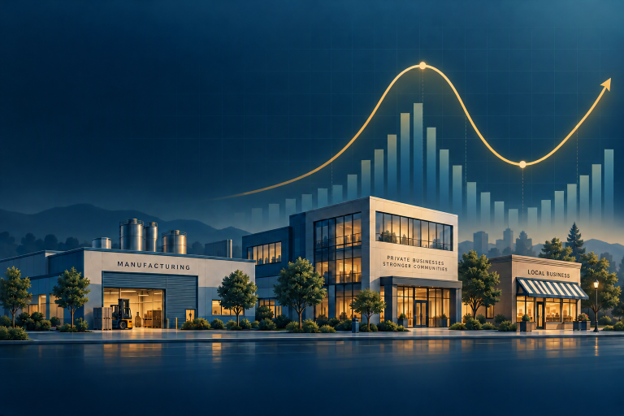
Business cycles influence the economic environment in which companies operate. As economies move through periods of expansion, peak growth, contraction, and recovery, market participants continually reassess future expectations, risk profiles, and investment opportunities. These changing perceptions often have a direct impact on private company valuation multiples and transaction activity.
Expansionary Periods Often Support Higher Valuations
During periods of economic growth, companies generally experience stronger demand, rising revenues, improving margins, and increased confidence among customers and investors. Access to capital becomes more readily available as lenders compete for quality borrowers and private equity firms seek acquisition opportunities.
In this environment, buyers are often willing to pay higher valuation multiples because they anticipate future earnings growth and perceive less risk. Strategic acquirers may pursue acquisitions more aggressively to expand market share, while financial buyers may have greater access to leverage, enabling them to justify higher purchase prices.
For business owners considering a sale, expansionary markets can provide attractive opportunities. A company generating stable cash flow during a strong economic cycle may receive valuation premiums as buyers compete for quality assets.
Economic Contractions Can Create Valuation Pressure
The opposite dynamic frequently occurs during economic slowdowns or recessions.
When uncertainty increases, buyers often become more cautious. Investors may shift focus from growth potential toward capital preservation, while lenders tighten underwriting standards and reduce leverage availability. As financing becomes more difficult to secure, transaction activity may decline and valuation multiples can compress across many industries.
Importantly, valuation declines during economic contractions are not always caused by deteriorating company performance. Sometimes the primary driver is a shift in market sentiment and investor expectations regarding future growth.
For example, a business generating $2 million in annual Free Cash Flow may experience little change in earnings, yet still see its market value decline if the cost of equity capital or weighted average cost of capital (WACC) increases by 50 Basis Points due to increased economic uncertainty (also referred to a “risk premium”).
This reality highlights a critical valuation principle: value is determined not only by current performance, but also by expectations about future performance.
Industry Sensitivity Matters
Not all businesses respond to economic cycles in the same way.
Companies operating in cyclical industries such as construction, manufacturing, automotive, hospitality, and consumer discretionary products often experience greater swings in valuation as economic conditions change. Their revenues may be closely tied to consumer confidence, business investment, or housing activity.
Conversely, businesses providing essential products and services frequently demonstrate greater resilience. Healthcare providers, business-to-business service firms with recurring contracts, software companies with subscription-based revenue models, and certain infrastructure-related businesses often maintain stronger valuations during periods of economic uncertainty because their cash flows are viewed as more predictable.
As a result, two companies with similar financial performance may receive very different valuations depending on how investors perceive the industry's exposure to economic cycles.
Interest Rates Play a Critical Role
One of the most important connections between business cycles and private company value is the cost of capital.
Interest rates influence both valuation models and transaction financing. When rates are relatively low, future cash flows become more valuable in present-value calculations, and acquisition financing becomes less expensive. These factors typically support higher business values.
When interest rates rise, borrowing costs increase and buyers must often generate higher returns to justify acquisitions. This can place downward pressure on valuations, particularly for highly leveraged transactions.
Private market valuations are therefore influenced not only by company performance but also by the broader financing environment in which buyers and investors operate.
Strong Companies Can Outperform the Cycle
Although business cycles affect valuation, exceptional companies often demonstrate the ability to preserve or enhance value regardless of economic conditions.
Businesses with the following characteristics tend to maintain stronger valuations throughout economic fluctuations:
Recurring and predictable revenue streams
Diversified customer bases
Consistent free cash flow generation
Low customer concentration
Strong management teams
Competitive market positioning
Scalable operations
Healthy balance sheets with manageable debt levels
These attributes reduce risk in the eyes of buyers and investors, making the company more attractive during both strong and challenging economic environments.
Valuation Is About Timing and Preparation
One of the most common misconceptions among business owners is that valuation depends solely on current financial results. In reality, timing and preparedness often play equally important roles.
Owners who regularly assess company value, understand industry trends, and monitor economic conditions are generally better positioned to capitalize on favorable market opportunities. Conversely, waiting until a liquidity event is imminent may limit strategic flexibility if economic conditions become unfavorable.
A proactive valuation strategy allows owners to identify value drivers, address weaknesses, improve operational performance, and prepare for potential ownership transitions long before they are required.
Looking Beyond the Current Cycle
While business cycles are inevitable, they are also temporary. Economic expansions eventually slow, and contractions ultimately give way to recovery and growth. The most successful business owners focus not only on current market conditions but on building durable enterprise value that can withstand changing economic environments.
At Benchmark Solutions, we believe that understanding the relationship between economic cycles and private company value is essential for making informed decisions regarding growth, buy-sell transactions, succession planning, and shareholder disputes. A well-supported valuation considers both company-specific fundamentals and the broader economic landscape because sustainable value is created where strong businesses and favorable market conditions intersect.
Business owners cannot control the economic cycle, but they can control how prepared their companies are to navigate it. Those who consistently focus on strengthening cash flow, reducing risk, and building long-term competitive advantages are often best positioned to maximize value regardless of where the economy stands today.
About Benchmark Solutions, Inc:
Benchmark Solutions provides business valuation & analysis, capital structure optimization, and strategic financial advisory services to business owners and investors and other business professionals navigating sales, acquisitions, financing decisions, and other complex financial transactions.
With extensive experience across beverage alcohol, agriculture, hospitality, healthcare, and technology, our team delivers the financial insights and analysis needed to make informed decisions.
If you would like to learn more about Benchmark Solutions, or request a free consultation, you can locate us online at Work With Us — Benchmark Solutions or visit us on LinkedIn at Benchmark Solutions, Inc.: Overview | LinkedIn
About the Author:
Paul B. Finch, MBA, is a founding Executive Director of Benchmark Solutions, Inc. and a Senior Valuation Analyst/Advisor at the firm. Professionally, Paul is an industry leader in Business and Financial Valuation specializing in business and commercial real estate analysis and valuation, capital structure optimization, the acquisition of financing, and the financial aspects of mergers and acquisitions for business owners, investors, and other business professionals. You can contact Paul at paul.finch@benchmarksolutions.us.com or on LinkedIn at Paul Finch, MBA | LinkedIn
This publication is intended for general informational purposes and does not constitute valuation, investment, legal, accounting, or tax advice. Conclusions concerning a specific business or ownership interest require analysis of the relevant facts and circumstances.
Copyright © 2026 by Benchmark Solutions, Inc. | All Rights Reserved